Part of our Core Hub on Personal Injury Compensation in Türkiye: This guide covers injuries caused by the state of a building or other structure, such as a broken stair, a loose handrail, a defective lift or a falling piece of a façade, in an apartment block, a hotel or a shopping centre. For the wider framework of bodily injury claims, medical costs and loss of earnings, see our main pillar: Personal Injury Compensation in Türkiye: Complete Claims Guide.
A claim against the owner of a building runs on the two-year and ten-year periods in TBK Article 72. Run the date of the accident and the date you learned who was liable through the checker for a first orientation, then read section 6 for the rule itself.
Open Claim Time-Limit Checker →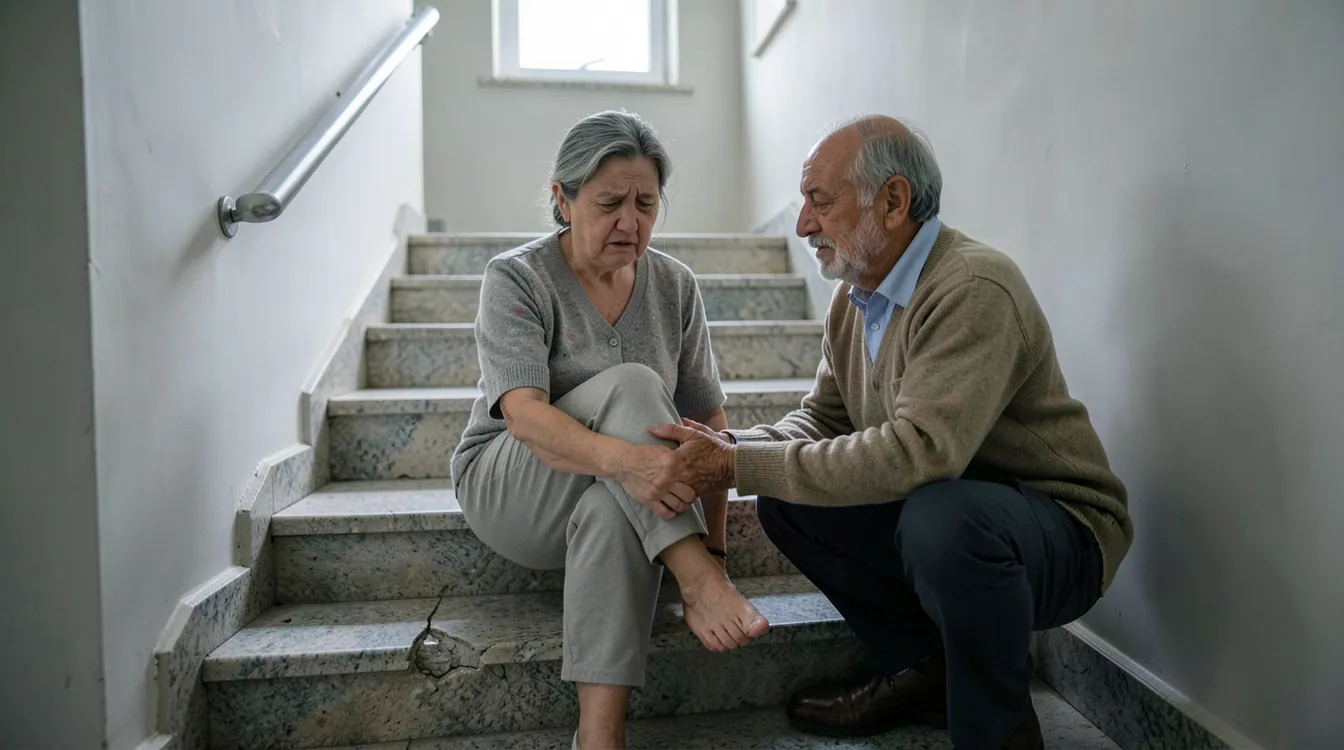
1. The Owner's Liability for Buildings and Structures (TBK Article 69)
Article 69/1 TBK reads, in substance: the owner of a building or of other structures (yapı eserleri) is obliged to make good the damage arising from defects in their construction (yapımındaki bozukluklar) or deficiencies in their maintenance (bakımındaki eksiklikler).
Two features of the wording matter for an injured visitor. First, Article 69/1 does not make the owner's obligation depend on the owner's own fault. The injured person does not have to show that the owner knew of the broken tread or was careless in not repairing it; the question is whether the tread was badly built or badly maintained. Second, unlike Article 66/2 for an employer, Article 69 does not give the owner a way out by proving that they took due care. This is why the owner's liability is described as strict, or no-fault, liability.
The rule is not limited by the wording to residents or guests. Article 69/1 speaks of the damage arising from the defect or the deficiency, so a passer-by on the street hit by a falling piece of a façade, a visitor on a staircase and a guest leaning on a balcony rail can all look to the same provision, provided the conditions in section 2 are met. Whether a particular installation, such as a lift, a canopy or an external stair, counts as part of the building or as an other structure in a given case is a matter the court assesses on the facts.
Article 69/3 adds that those who are liable keep their right of recourse against other persons who are answerable to them for these causes. That sentence concerns the relationship between the owner and, for example, a builder or a maintenance contractor, depending on the contracts and the facts. It does not shift the claim away from the person whom Article 69 makes liable towards the injured person.
2. What the Injured Person Has to Show: Defect or Maintenance Deficiency, Damage and Causation
Strict liability is not automatic compensation. Under Article 69, the injured person still has to establish three things, and each one can be disputed.
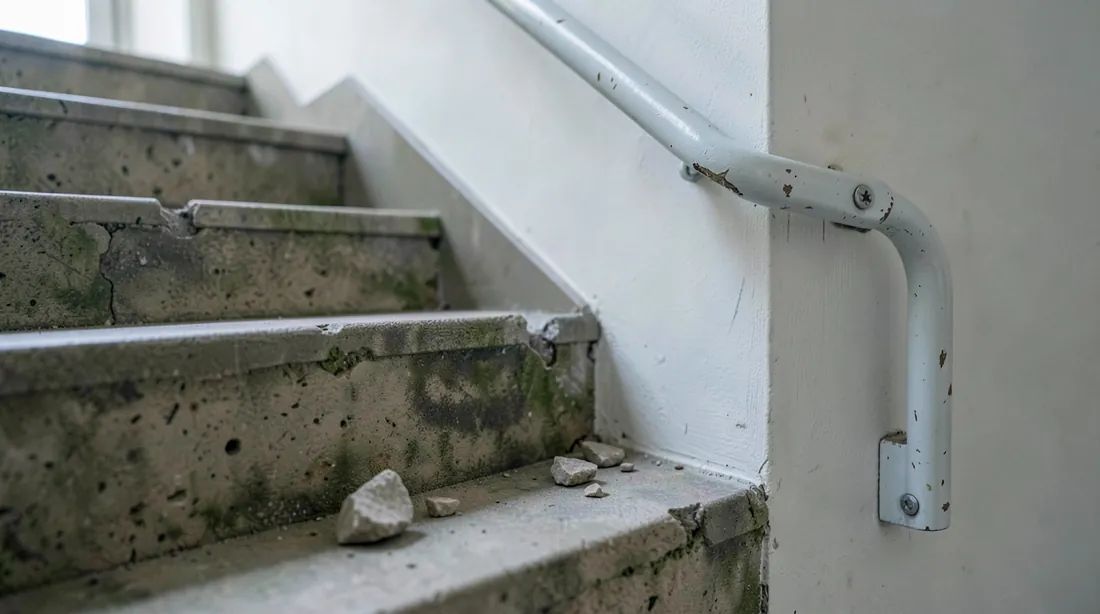
A construction defect or a maintenance deficiency. The article covers two different causes. A construction defect concerns how the building or structure was made: a stair built with uneven risers, a façade element fixed in an unsuitable way, a railing placed too low. A maintenance deficiency concerns how it was kept: a cracked tread left unrepaired, a handrail bracket with missing screws, a loose piece of cladding that was not secured. Which of the two applies matters for the question of who is liable, as section 3 shows. Whether there was a defect or deficiency at all is a factual and, where needed, technical question for the court.
Damage. In a personal injury case, the damage is the bodily harm and its financial consequences, together with any claim for moral damages. Section 5 lists the heads of damage the Code names.
Causation. The injury must arise from the defect or deficiency. A fall on a staircase can have many causes: the broken nosing of a tread, poor lighting, a wet surface, unsuitable footwear, a moment of distraction. The owner may argue that the fall had nothing to do with the state of the building. This is where early evidence decides cases: photographs of the step taken before repair, the medical record of where and how the injury happened, and witnesses who saw the fall.
If the court finds the conditions met, the owner cannot defend the claim simply by showing that they were careful. They can, however, dispute the defect, the damage or the causal link, and they can invoke the injured person's own conduct under Article 52 (section 4).
3. Apartment Blocks, Hotels and Shopping Centres: Owner, Usufruct and Residence-Right Holders, Operator (TBK 69/2, 66)
The owner. Article 69/1 places the obligation on the owner. In a detached house or a hotel building owned by one company, identifying the owner is straightforward. In an apartment block divided into separate units, the building may belong to many owners, and who exactly is to be sued for an accident on the common staircase, in the lift or under the façade depends on the land registry records and the facts. A lawyer can check the title records before a claim is addressed to anyone.
Usufruct and residence-right holders. Under Article 69/2, the holders of a usufruct (intifa) or a right of residence (oturma hakkı) are liable jointly and severally with the owner (müteselsilen) for damage arising from deficiencies in the maintenance of the building. The paragraph is narrower than paragraph 1: it covers maintenance deficiencies only, not construction defects. For an injured person, joint and several liability means that the claim for maintenance-related damage can be directed at the owner, at the usufruct or residence-right holder, or at both.
The operator of a hotel or shopping centre as employer. A hotel or shopping centre may be run by a company that does not own the building. Its liability then rests on other provisions. Under Article 66/1, a person who employs others is obliged to make good the damage that an employee causes to others while carrying out the work assigned. Under Article 66/2, the employer is not liable if it proves that it took the care required in selecting, instructing, supervising and controlling the employee. Article 66/3 sets a stricter rule for enterprises: a person who employs others in an enterprise is liable for damage caused by the activities of that enterprise unless it proves that the enterprise's working organisation was suitable to prevent the damage from occurring.
This matters where the accident was caused less by the building than by how the place was run: a freshly mopped floor left without warning, a cleaning cart parked across a staircase, a broken lift left in service. Whether a given accident arises from the enterprise's activities, and whether the working organisation was suitable, are questions the court assesses on the evidence. Where a building defect and an operational failure both played a part, the owner and the operator may each come into question on their own legal basis.
Accidents inside a hotel room, on an excursion or at the pool raise further questions that are covered in our guide to hotel, resort and excursion accident claims. Damage to property rather than to a person, such as water coming through the ceiling from the flat above, is discussed in our guide to water leaks from an upstairs flat.
4. Fault Liability as a Parallel Route and the Victim's Own Conduct (TBK 49-52)
Article 69 does not replace the general rule of liability for fault. Under Article 49/1, a person who causes damage to another by a faulty and unlawful act is obliged to make it good. The difference lies in what has to be proved: under Article 50/1, the injured person must prove the damage and the fault of the person who caused it. Where the amount of the damage cannot be fully proved, Article 50/2 lets the judge determine it equitably, taking into account the ordinary course of events and the measures the injured person took.
Fault liability can be relevant where the person responsible for the accident is not the owner, for example someone who left a dangerous obstacle on a dark landing, or where the claimant prefers to rely on both grounds. Under Article 51/1, the judge determines the extent and the manner of payment of compensation by considering the circumstances and, in particular, the degree of fault; if compensation is awarded as a periodic payment (an annuity), the debtor must provide security.
The injured person's own conduct. Under Article 52/1, if the injured person consented to the harmful act, contributed to the occurrence or increase of the damage, or worsened the position of the person liable, the judge may reduce the compensation or remove it entirely. A fall on a broken stair while hurrying in the dark, or after ignoring a barrier placed in front of a damaged step, raises exactly the questions Article 52 leaves to the judge's assessment.
5. What Can Be Claimed: Medical Costs, Lost Earnings, Interest and Moral Damages (TBK 54-56)
Article 54 lists the heads of bodily damage. They are, in particular:
- Treatment costs: hospital, surgery, medication, physiotherapy and related expenses.
- Loss of earnings: the income lost during the period of incapacity.
- Losses arising from the reduction or loss of working capacity, where the injury leaves a lasting impairment.
- Losses arising from the impairment of economic future.
How the amount is calculated. Under Article 55/1, bodily damage is calculated according to the provisions of the Code and the principles of liability law. Social security payments that cannot be recovered by recourse, in whole or in part, and payments that are not made for the purpose of performance cannot be taken into account in determining such damage and cannot be deducted from the damage or the compensation. The calculated compensation cannot be increased or reduced on equitable grounds by reference to its amount.
Interest after the 2026 amendment. Law No. 7589 of 16 July 2026 added two paragraphs to Article 55. For losses arising from the reduction or loss of working capacity, statutory interest runs on the total compensation calculated for the period in which the injured person's earnings are known from the date of the tort or harmful event, and on the total calculated for the period in which earnings cannot be known from the date of the judgment. Our statutory interest calculator can give a first orientation on the interest component.
Payments made before the evidence stage. The second new paragraph provides that, for compensation for those losses, a sum paid for the purpose of performance before the taking of evidence (tahkikat) begins is deducted proportionally from the compensation determined as at the date of payment. If an owner, an operator or an insurer pays something early, keep a record of the date and the amount, because both matter for this calculation.
Moral damages. Under Article 56/1, where bodily integrity is harmed, the judge may, taking into account the particular circumstances of the event, award an appropriate sum of money to the injured person as compensation for non-pecuniary damage. Under Article 56/2, in the case of serious bodily harm or death, the relatives of the injured person may also be awarded such compensation.
6. The Limitation Period, a Reserved Judgment and Interim Payment (TBK 72, 75, 76)
Limitation. Under Article 72/1, a claim for compensation becomes time-barred (zamanaşımına uğrar) on the expiry of two years from the date on which the injured person learned of the damage and of the person liable, and in any event ten years from the date of the act. If the compensation arises from an act that is punishable and for which the criminal laws provide a longer limitation period, that longer period applies. For a visitor who left Türkiye after the accident, the two-year period runs from knowledge of both the damage and the person liable; establishing early who owns or operates the building is therefore part of protecting the claim.
A reserved judgment. An injury to an ankle, a knee or the spine can develop over months. Under Article 75, if the extent of the bodily damage cannot be fully determined when the judgment is given, the judge may reserve the right to amend the judgment on compensation within two years from the date it becomes final. A claimant whose condition is still developing can ask the court to consider this reservation.
Interim payment. Under Article 76, where the injured person presents convincing evidence showing that the claim is justified and their economic situation requires it, the judge may, on request, order the defendant to make an interim payment (geçici ödeme). Interim payments are deducted from the compensation awarded; if no compensation is awarded, the judge orders the claimant to return them together with statutory interest.
For a person living abroad, the claim can be handled by a lawyer in Türkiye under a written power of attorney signed before a Turkish consulate, or before a notary abroad with an apostille. Medical records from treatment in the home country can support the claim for later treatment costs and lost earnings; translations may be needed.
7. Before Anyone Is Hurt: Demanding Preventive Measures (TBK 70)
Some readers will find this page before anyone is hurt: a neighbour notices a loose handrail, a resident sees cracks spreading in a balcony slab, a shop owner watches pieces of render fall from the building next door. Article 70/1 gives such a person a direct right. A person who faces the danger of being harmed by a building or other structure belonging to someone else may demand that the persons entitled take the measures necessary to remove that danger.
Under Article 70/2, the rules of public law on the protection of persons and property are reserved. That sentence leaves room for the competent public authorities to act under their own legislation, which this guide does not cover. On the private-law side, a written demand under Article 70 that describes the danger and asks for repair, sent to the owner and the building management, both serves its own purpose and, if an accident later happens, records that the deficiency was known.
8. Three Routes Compared and a Checklist for a Foreign Victim
The three routes can overlap. A single fall on a hotel staircase may raise the owner's liability for a broken tread, the operator's liability for how the stairwell was cleaned and lit, and the fault of a third person. The table sets out what each route requires; which one, or which combination, fits a case depends on the evidence.
| Question | Owner's liability (TBK 69) | Fault liability (TBK 49-50) | Employer or operator (TBK 66) |
|---|---|---|---|
| Who is liable | The owner of the building or other structure (69/1); for maintenance deficiencies, also usufruct and residence-right holders, jointly and severally (69/2) | The person who caused the damage by a faulty and unlawful act (49/1) | The employer for damage an employee causes while doing the assigned work (66/1); in an enterprise, the employer for damage caused by the enterprise's activities (66/3) |
| What the injured person proves | Damage, a construction defect or maintenance deficiency, and the causal link | The damage and the fault of the person who caused it (50/1), together with an unlawful act causing the damage (49/1) | Damage caused by the employee in the course of the work, or damage caused by the enterprise's activities |
| Can the defendant escape by proving care? | Article 69 provides no such defence; those liable keep a right of recourse against persons answerable to them (69/3) | Without fault there is no liability under Article 49/1 | Yes: due care in selecting, instructing, supervising and controlling (66/2); in an enterprise, a working organisation suitable to prevent the damage (66/3) |
| Situations where it may be relevant | A stair tread that breaks because it was badly built or left unrepaired; a falling piece of a façade; a detached handrail | A person whose careless act, such as leaving an obstacle on an unlit landing, caused the fall | An unmarked wet floor or a cleaning cart on a staircase in a hotel or shopping centre run by an operator |
| Reduction of compensation | The judge assesses the injured person's own conduct and may reduce or remove compensation (52/1) | Same (52/1); the degree of fault also bears on the extent of compensation (51/1) | Same (52/1) |
Checklist for a foreign victim
- Get medical care first and keep the record: the emergency report, imaging, discharge summary and every invoice for treatment, medication and physiotherapy, because these support the heads of damage in TBK Article 54.
- Photograph the place before anything is repaired: the broken tread or loose handrail close up and in a wider view showing the staircase, the lighting and any warning signs, with the date and time of the photographs preserved in the original files.
- Note the witnesses: names and contact details of neighbours, guests, staff or passers-by who saw the fall or the state of the place.
- Notify the building manager, the hotel or the shopping-centre management in writing: describe what happened, where, and the defect you saw, and ask them to keep any camera footage. Keep a copy of the message and any reply.
- Find out who owns and who runs the building: the owner for TBK Article 69, any usufruct or residence-right holder for maintenance deficiencies (69/2), and the operating company for TBK Article 66.
- Keep proof of your earnings before the accident and of the days or months you could not work, for the loss-of-earnings and working-capacity heads (TBK 54).
- Record any payment offered or made, with its date and amount, in view of the proportional deduction rule added to TBK Article 55 in 2026.
- Diary the limitation period: two years from learning of the damage and of the person liable, ten years at the latest from the act (TBK 72).
A fall caused by a broken step or a loose handrail is not only bad luck. Turkish law makes the owner answer for construction defects and maintenance deficiencies without asking whether the owner was careful, but the injured person still has to show the defect, the damage and the link between them. Securing that evidence early, identifying the owner and the operator, and keeping the two-year limitation period in view are the steps that keep the claim open.
Scope. This page describes the Turkish rules as in force in October 2026: Articles 49 to 52, 54 to 56 (including the paragraphs added to Article 55 by Law No. 7589 in July 2026), 66, 69, 70, 72, 75 and 76 of the Turkish Code of Obligations No. 6098. It does not cover technical regulations on lifts, hotels or shopping centres, contractual claims, insurance cover, or criminal proceedings. Each case turns on its own facts and evidence.
Frequently Asked Questions
I fell on a broken stair in an apartment building in Türkiye. Who can I claim against?
Under Article 69/1 of the Turkish Code of Obligations, the owner of a building or other structure is obliged to make good the damage arising from defects in its construction or deficiencies in its maintenance. Under Article 69/2, usufruct and residence-right holders are also liable, jointly and severally with the owner, for damage arising from maintenance deficiencies. Where the building is run by an operating company, its liability as an employer under Article 66 may also come into question.
Do I have to prove that the owner was at fault?
No. Article 69/1 does not make the owner's obligation depend on fault, and it does not let the owner escape by proving due care. The liability is not automatic, however: you must show the damage, a construction defect or maintenance deficiency, and that your injury arose from it. The owner can dispute each of these and can invoke your own conduct under Article 52.
I was injured in a hotel or a shopping centre. Is the operator liable, or the owner of the building?
Both may come into question, on different legal bases. The owner of the building is liable under Article 69 for construction defects and maintenance deficiencies. An operator that employs staff in an enterprise is liable under Article 66/3 for damage caused by the enterprise's activities unless it proves that its working organisation was suitable to prevent the damage. Which applies depends on what caused the accident, and the court assesses it on the evidence.
What if I was partly to blame for my fall?
Under Article 52/1, if the injured person contributed to the occurrence or increase of the damage, the judge may reduce the compensation or remove it entirely. The wording is permissive: the judge decides on the facts of the case whether, and to what extent, to reduce.
How long do I have to bring a claim?
Under Article 72/1, the claim becomes time-barred two years from the date on which you learned of the damage and of the person liable, and in any event ten years from the date of the act. If the act is punishable and the criminal laws provide a longer limitation period, that period applies.
Can I claim for pain and suffering as well as my medical bills?
Yes, if the conditions are met. Article 54 lists treatment costs, loss of earnings, losses from reduced or lost working capacity and losses from the impairment of economic future. Separately, under Article 56/1, where bodily integrity is harmed, the judge may award an appropriate sum as moral damages, taking the particular circumstances of the event into account.
My injury may get worse. Can the judgment take that into account?
Under Article 75, if the extent of the bodily damage cannot be fully determined when the judgment is given, the judge may reserve the right to amend the judgment within two years from the date it becomes final. Under Article 76, the judge may also order an interim payment on request, where you present convincing evidence that the claim is justified and your economic situation requires it.
A piece of the façade fell next to me but I was not hurt. Can I make the owner fix it?
Yes. Under Article 70/1, a person who faces the danger of being harmed by a building or other structure belonging to someone else may demand that the persons entitled take the measures necessary to remove the danger. Under Article 70/2, public-law rules on the protection of persons and property are reserved.
Talk to someone about an injury in a building
Send us the address of the building and what kind of place it is, the date and a short account of the accident, photographs of the place, your medical reports, the names of any witnesses, and any message you have sent to or received from the building manager, the owner or the operator. We will tell you how the rules on the owner's and the operator's liability apply to your facts and what the next step should be.