Part of our Core Hub on Property Disputes in Türkiye: This guide covers water damage from the flat above, a neighbour's pipe or the building's common pipes: first steps, preserving evidence, who is liable, the building manager's duties, mediation and court, time limits and your own insurer's role. For the full picture of property problems foreign owners and buyers face, see Property Disputes in Türkiye for Foreign Buyers.
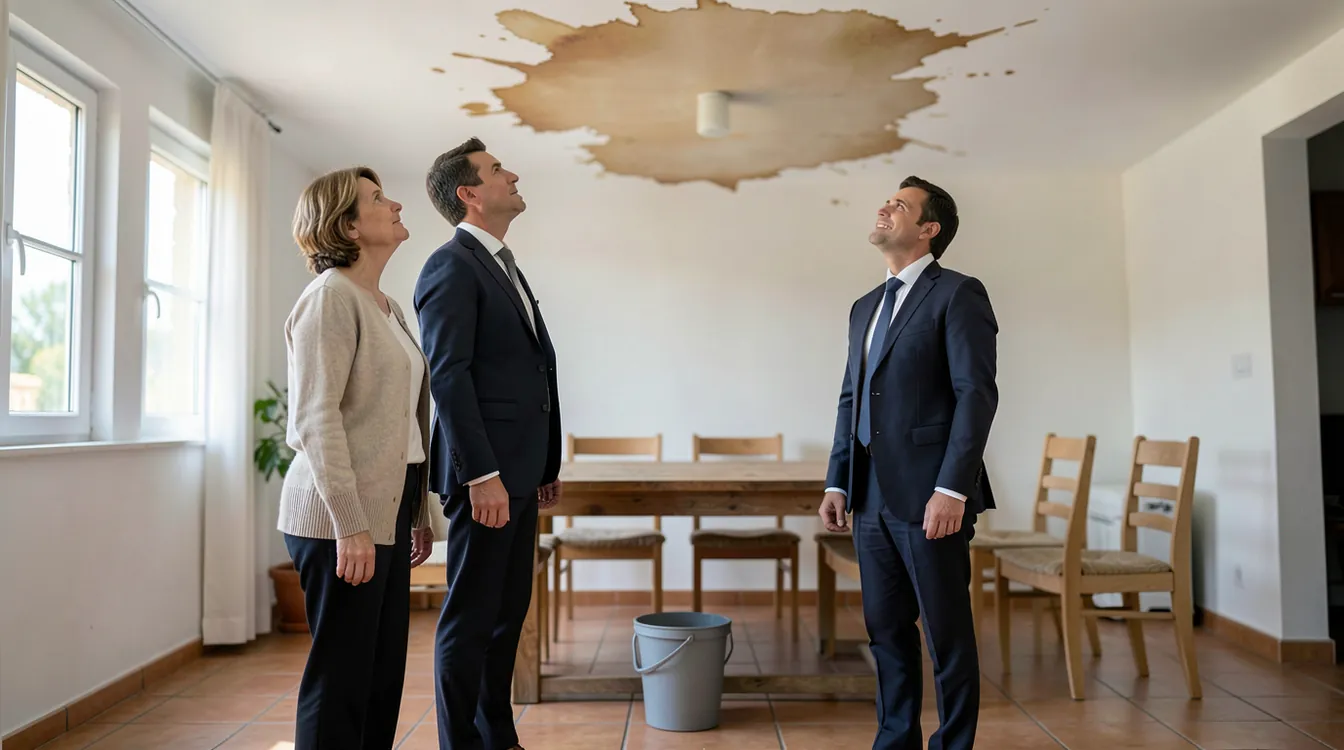
1. The First Hours: Stop the Water, Record It, Notify Your Insurer (TTK 1446)
The first task is practical: stop the water. If the leak is active, ask the occupant of the flat above to close their main valve, and if nobody answers, tell the building manager (yönetici) or the caretaker, who can reach the building's shut-off points. Move furniture, electronics and documents away from the wet area, and switch off electricity in the affected rooms if water is near sockets or light fittings. These steps protect your belongings, and the measures you take to limit the damage are among the things the judge considers when the amount cannot be exactly proved (section 5).
Then record what you see, before anything is cleaned or repaired. Take dated photographs and a slow video of every affected ceiling, wall and floor, of damaged furniture and appliances, and of the water itself where it is still dripping. Photograph the flat above too if the occupant lets you in, especially the bathroom, kitchen and any visibly wet area. Keep the plumber's name and a written description of what they found.
Tell the neighbour and the building manager in writing, even if you have already spoken. A short message stating the date, what happened and that you reserve your rights is enough at this stage, and it fixes the moment when the other side learned of the problem.
If you hold your own home or contents insurance, notify the insurer. Under Article 1446 of the Turkish Commercial Code (Türk Ticaret Kanunu, TTK) No. 6102, the policyholder must notify the insurer without delay once they learn that the insured risk has occurred. If failing to notify, or notifying late, has increased the amount of the indemnity, the insurer may reduce payment according to the severity of the policyholder's fault; there is no reduction if the insurer learned of the event earlier by other means. Whether your policy covers water damage at all depends on its own terms, which this guide does not address.
2. Preserve the Evidence Before Repairs (HMK 401-402)
Repairs destroy evidence. Once the ceiling is replastered or the pipe in the flat above is replaced, it becomes hard to show where the water came from, how long it had been leaking and how far it spread. Turkish procedure offers a way to fix the evidence first: the determination of evidence (delil tespiti) under the Code of Civil Procedure (Hukuk Muhakemeleri Kanunu, HMK) No. 6100.
Under Article 401, before a lawsuit is filed, the determination is requested either from the court that will hear the main case or from the civil court of peace (sulh hukuk mahkemesi) of the place where the thing to be inspected or examined by an expert is located. For a leak, that is the court of the district where the building stands. The same Article reserves the fact determination by notaries: a notary can record what is visible at a given moment, which can help where speed matters, while a court determination with an expert can also address the cause.
Article 402 sets out the request. It is made by petition, stating the fact to be determined, the questions to be put to the expert or witnesses, the reasons for fearing that the evidence will be lost or become difficult to present, and the name and address of the person against whom the determination is sought. The court fixes the costs of the determination, and no further step is taken until they are paid as an advance. If the court grants the request, the decision is served on the other side together with the petition; the decision states how and when the determination will take place, that the other side may attend, and that any objections and additional questions must be notified within one week. After the determination, the court serves a copy of the minutes and any expert report on the other side of its own motion.
Useful questions for the expert include: where the water entered the flat, whether the source is a pipe or fitting belonging to the flat above or a common pipe of the building, whether the cause is a construction defect, a lack of maintenance or the way the flat above was used, the extent of the damage in each room, and the repair work needed. Clear questions give the later claim a clear basis.
A leak discovered late, or one that has recurred for months, raises a time-limit question from the start. Use our time-limit check to see which limitation rules Turkish law applies to claims like yours before you speak to a lawyer.
Open Time-Limit Check →3. Who Is Liable: the Owner Above, the Occupant, the Building (TBK 49, 69; KMK 18, 19)
Turkish law gives several bases of liability, and they are not alternatives in the abstract: which one fits depends on where the water came from and why.
The owner of the building or of the unit, for defects and deficient maintenance. Article 69 of the Turkish Code of Obligations (Türk Borçlar Kanunu, TBK) No. 6098 states that the owner of a building or other construction work is obliged to compensate the damage arising from defects in its construction or deficiencies in its maintenance. The text of Article 69 does not include a fault requirement. Its second paragraph adds that holders of a usufruct or a right of residence are liable jointly (müteselsilen) with the owner for damage arising from deficient maintenance of the building, and the third paragraph reserves the right of recourse of those held liable against others who are liable to them. A corroded pipe in the flat above that was never maintained is the kind of situation this provision addresses; whether it applies to a specific leak is decided on the expert evidence.
The unit owner who caused the damage by fault. The Condominium Law (Kat Mülkiyeti Kanunu, KMK) No. 634 contains a specific rule. Under the third paragraph of Article 19, every unit owner is liable towards the other unit owners for damage they cause by their fault to the main property and to the other independent units. The first paragraph of the same Article obliges the unit owners to maintain the main property and to preserve its soundness with care.
Tenants and other occupants of the flat above. Article 18 of the KMK requires unit owners, when using their units, the annexes and the common areas, to act in good faith, in particular not to disturb one another, not to infringe one another's rights and to comply with the management plan. Its second paragraph extends the provisions of the Law on unit owners' obligations to tenants, holders of a right of residence and anyone who otherwise uses a unit on a continuing basis, and makes those who fail to perform these obligations liable jointly with the unit owners. A tenant upstairs who leaves a bath overflowing does not stand outside the Law.
The general rule of fault liability. Article 49 of the TBK obliges anyone who causes damage to another by a faulty and unlawful act to compensate it. This rule is not limited to unit owners, so it is also the natural basis for a tenant living downstairs whose own belongings were damaged, and for claims against a neighbour in an adjacent building. Its second paragraph covers intentional damage caused by an act contrary to morals.
Your lease may give you, as a tenant downstairs, separate rights against your own landlord concerning repairs to the flat you rent; those contractual rights are outside the scope of this guide.
4. Common Pipes, the Roof and the Building Manager (KMK 19, 34, 35)
Not every leak comes from the flat above. Water can come from a vertical riser shared by the whole building, a drain stack, the roof, a terrace or a water tank. These are common parts, and the rules shift towards the building as a whole.
The first paragraph of Article 19 of the KMK makes the unit owners responsible for the maintenance and soundness of the main property. The second paragraph requires the written consent of four-fifths of all unit owners before an owner has construction or repair work done in the common areas. It then makes an exception that matters for leaks: where a court has determined that a defect in the common areas or installations is damaging the main structure or an independent unit and must be repaired urgently, the unit owners' consent is not required for carrying out the repair in accordance with its project and technique. The same paragraph prohibits a unit owner from carrying out repairs in their own unit that would damage the main structure, and allows repairs at connected points of units joined by a ceiling, floor or wall with the joint consent of the owners of those units, provided the work does not damage the main structure.
The building manager has defined duties. Under Article 34, appointing a manager is mandatory where the building has eight or more independent units. Under Article 35, unless the management plan provides otherwise, the manager takes the measures necessary for the protection, maintenance and repair of the main property, has the main property insured, and takes the measures needed for its protection and maintenance in the interest of the unit owners and on their behalf. What that building insurance covers is a question of the policy itself; ask the manager for a copy and for the insurer's details as soon as a common pipe is suspected.
Concretely, a written notice to the manager describing the leak, the suspected common source and the damage it is causing is the first step. If nothing is done, the court routes described in section 6 are available.
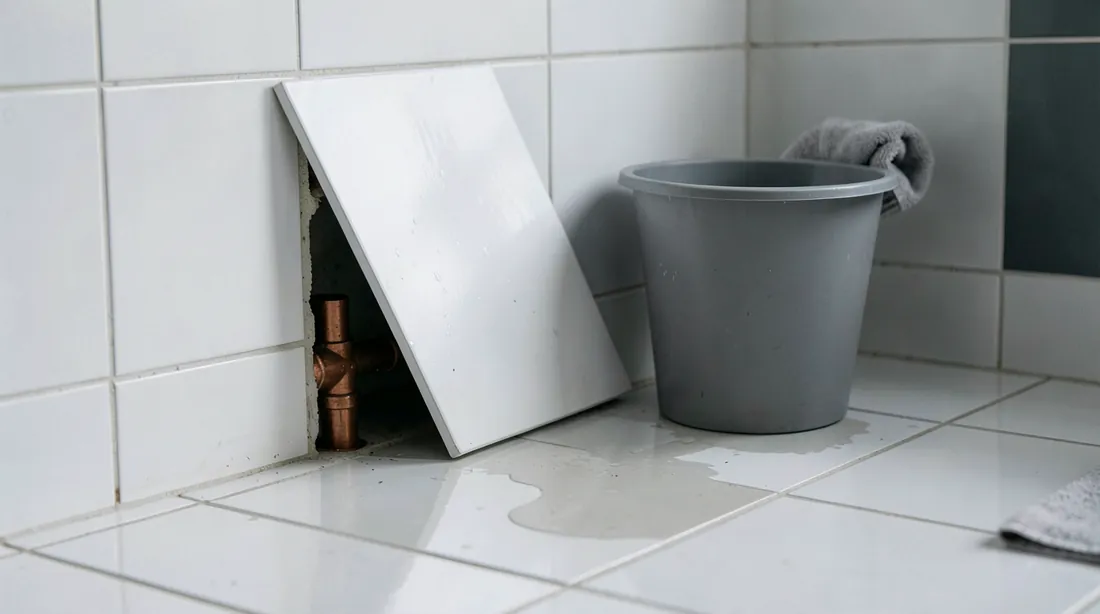
5. Proving and Measuring the Loss (TBK 50-51)
A claim is only as good as its proof. Under Article 50 of the TBK, the injured party must prove the damage and the fault of the person who caused it. Where the exact amount of the damage cannot be proved, the judge determines it equitably, taking into account the ordinary course of events and the measures taken by the injured party. That second sentence is one more reason to act quickly: the steps you took to limit the damage are part of what the court considers.
Article 51 lets the judge determine the scope of the compensation and the manner of payment according to the circumstances and, in particular, the severity of the fault. The court's assessment of a leak case therefore rests on the evidence file, and a well-kept file makes that assessment easier.
The heads of loss that can be documented include:
- Repair of the damaged unit: ceilings, walls, plaster, paint, flooring, doors and built-in furniture, supported by the expert's findings and repair quotes or invoices.
- Damaged belongings: furniture, appliances, electronics, textiles and documents, with photographs, purchase records and a list prepared while the damage is fresh.
- Drying and emergency work: the plumber's call-out, dehumidifiers, cleaning, with receipts.
- Loss of use: where the flat or a room could not be used, or rent was lost on a let property, supported by the lease, booking records or other documents.
- Costs of the evidence: the determination of evidence and any notary record, with the court's and the notary's receipts.
6. Mediation First, Then the Civil Court of Peace (Law 6325 Article 18/B, KMK 33, Ek 1)
Before suing, check whether mediation is required. Under Article 18/B of the Law on Mediation in Civil Disputes (Hukuk Uyuşmazlıklarında Arabuluculuk Kanunu) No. 6325, as amended by Law No. 7445 in 2023, in disputes arising from the Condominium Law No. 634 (sub-paragraph (c)) and disputes arising from neighbour law (sub-paragraph (ç)), applying to a mediator before filing the lawsuit is a condition of the action (dava şartı). Whether a particular leak claim falls into one of these categories is assessed on its facts, so have it checked before filing; a lawsuit filed without a required mediation application faces a procedural obstacle.
Mediation also affects time limits. Under Article 18/A(15), from the application to the mediation office until the final minutes are drawn up, the limitation period is suspended and time limits for loss of rights do not run. Mediation can end the dispute on agreed terms: the upstairs owner, the occupant or the building's insurer paying for the repair.
If mediation fails, the court question follows. Under Additional Article 1 (Ek Madde 1) of the KMK, all disputes arising from the application of the Condominium Law are resolved in the civil courts of peace. Article 33 gives a faster tool for the continuing problem: under its second paragraph, a unit owner harmed because another unit owner or that owner's tenant does not perform their obligations may apply to the civil court of peace and ask for the judge's intervention. The judge decides without delay and sets a short period for compliance; failure to comply is sanctioned with an administrative fine. This route is aimed at stopping the cause, for example forcing the repair of a leaking installation upstairs, while the compensation claim addresses the damage already done.
For an owner who lives abroad, the whole route can be handled by a lawyer in Türkiye on the basis of a written authority you sign at a Turkish consulate or before a notary abroad with an apostille. The court may still ask you for original documents or a statement during the case.
7. Time Limits and Your Own Insurer's Role (TBK 72, TTK 1472)
Compensation claims arising from a tort, which include claims under Articles 49 and 69 of the TBK, are subject to Article 72. The claim becomes time-barred (zamanaşımına uğrar) on the expiry of two years from the date on which the injured party learned of the damage and of the person liable, and in any event ten years from the date of the act. If the act also constitutes an offence for which criminal law provides a longer limitation period, that longer period applies. For a leak that continues or recurs, the dates that matter should be fixed early and the applicable period checked for the specific file; the mediation suspension described in section 6 is part of that calculation.
Your own insurer may pay first. If it does, Article 1472 of the TTK applies: the insurer that pays the indemnity takes the place of the insured by law (subrogation, halefiyet), and the right to sue those responsible for the damage passes to the insurer up to the amount it has paid. The insurer can continue a lawsuit or enforcement proceedings already started, from where they stand. If the insured impairs these rights, the insured is liable to the insurer. Where the insurer has compensated only part of the loss, the insured keeps the right to claim the uncovered part from those responsible.
This has two consequences. Do not sign a full release in favour of the upstairs owner or their insurer after your own insurer has paid, without checking how it affects the insurer's rights. And keep pursuing the part of your loss the policy did not cover, such as a deductible or excluded items, because Article 1472 reserves that part to you. For disputes with your own insurer about a denied or reduced payment, see our insurance claim disputes page.
8. Sources of a Leak Compared and a Checklist for Owners Abroad
The table sets out who may be liable depending on where the water came from. It is a starting map, not a conclusion: in a single leak more than one basis can apply at once, for example a corroded pipe upstairs combined with a tenant who ignored the dripping for weeks, and the court decides on the evidence.
| Source of the leak | Who may be liable | Legal basis | Evidence to keep |
|---|---|---|---|
| A pipe, fitting or appliance inside the flat above | The owner of that flat; a usufruct or residence right holder jointly for deficient maintenance | TBK 69; KMK 19/3 where the owner is at fault; TBK 49 | Expert or notary record of the source, plumber's note, photos of both flats |
| An overflowing bath, a tap left running, a washing machine hose | The person who caused it; a tenant upstairs jointly with the owner for the owner's obligations | TBK 49; KMK 19/3; KMK 18/2 | Written notice and replies, witness details, the manager's record of the incident |
| A common riser, drain stack, roof or terrace | The unit owners together, acting through the manager | KMK 19/1 and 19/2; KMK 35 (maintenance, repair, insurance); KMK 33/2 and Ek 1 | Written notices to the manager, repair requests, court determination of urgency |
| A pipe in an adjacent building | The owner of that building, or the person at fault | TBK 69; TBK 49; neighbour-law mediation (Law 6325 Article 18/B(ç)) | Determination of evidence at the civil court of peace where the building stands |
| Any source, where your own insurer has paid | The insurer steps into your claim up to the amount paid; you keep the uncovered part | TTK 1446 (notice), TTK 1472 (subrogation) | Notice to your insurer, the payment statement, a list of uncovered items |
Checklist for an owner who lives abroad
- Give someone in Türkiye access: a neighbour, a property manager or a lawyer who can open the flat, stop the water and photograph the damage if you are abroad.
- Keep the building manager's and the upstairs neighbour's contact details, and ask the manager for the building insurer's details before anything happens.
- On discovery, stop the water and record everything with dated photos and video, in both flats if possible.
- Notify in writing: the neighbour, the manager and, without delay, your own insurer (TTK Article 1446).
- Fix the evidence before repairs with a determination of evidence at the civil court of peace or a notary's fact record (HMK Articles 401 and 402).
- Keep every receipt: plumber, drying, cleaning, replacement items, and the costs of the evidence.
- Check whether mediation is required before suing (Law 6325 Article 18/B), and note that it suspends the limitation period (Article 18/A(15)).
- Diary the time limit: two years from learning of the damage and the person liable, and in any event ten years from the act (TBK Article 72).
A leak from above is a property problem with a clear legal structure. The owner's part is to stop the water, fix the evidence before the repair, identify the source and the right basis of liability, go through mediation where it is required and keep an eye on the time limit, while making sure that any payment from an insurer does not cost the uncovered part of the claim.
Scope. This page describes the Turkish rules as in force in September 2026: Articles 49, 50, 51, 69 and 72 of the Turkish Code of Obligations No. 6098; Articles 18, 19, 33, 34, 35 and Additional Article 1 of the Condominium Law No. 634; Articles 401 and 402 of the Code of Civil Procedure No. 6100; Articles 18/A and 18/B of Law No. 6325 on Mediation in Civil Disputes; and Articles 1446 and 1472 of the Turkish Commercial Code No. 6102. It does not address the terms of any insurance policy. It is general information, not advice on a particular case; which court is competent, the time limits, the costs and the outcome depend on the facts, the documents and the court's assessment.
Frequently Asked Questions
Water from the flat above damaged my apartment in Türkiye. Who pays for the repair?
It depends on the source and the cause. Under Article 69 of the Turkish Code of Obligations, the owner of a building is obliged to compensate damage arising from defects in its construction or deficiencies in its maintenance. Under Article 19/3 of the Condominium Law, a unit owner is liable to the other unit owners for damage caused by their fault. Anyone who causes damage by a faulty and unlawful act is liable under Article 49 of the Code of Obligations.
The flat above is rented out. Is the tenant or the owner responsible?
Possibly both. Article 18 of the Condominium Law applies the provisions on unit owners' obligations to tenants as well, and makes those who fail to perform them jointly liable with the unit owners. A tenant who caused the leak by fault is also liable under Article 49 of the Code of Obligations. Which of them is liable in a given case is decided on the evidence.
How do I prove where the water came from once the plumber has fixed it?
Ideally, fix the evidence before the repair. Under Articles 401 and 402 of the Code of Civil Procedure, you can ask the civil court of peace where the building is located for a determination of evidence, with an expert answering your questions about the source and the extent of the damage. A notary's fact determination is also possible. Photos, videos, messages and the plumber's written note support either route.
The leak comes from a common pipe of the building. What can I do?
Notify the building manager in writing. Under Article 35 of the Condominium Law, the manager takes the measures necessary for the protection, maintenance and repair of the main property and has it insured. If a court determines that a defect in the common installations is damaging a unit and must be repaired urgently, Article 19/2 allows the repair without the four-fifths consent of the owners. The civil court of peace hears disputes under the Condominium Law (Additional Article 1).
Do I have to go to mediation before suing my neighbour?
For disputes arising from the Condominium Law and disputes arising from neighbour law, Article 18/B of Law No. 6325 makes applying to a mediator before filing the lawsuit a condition of the action. Whether your claim falls into one of these categories should be checked on the facts. The limitation period is suspended from the application to mediation until the final minutes (Article 18/A(15)).
My own insurer paid part of the damage. Can I still claim the rest from the neighbour?
Yes, for the part that was not covered. Under Article 1472 of the Turkish Commercial Code, an insurer that pays takes your place by law against those responsible, up to the amount it paid, and where it compensated only part of the loss you keep the right to claim the remaining part. Avoid signing any release that could impair the insurer's rights, because Article 1472 makes the insured liable to the insurer in that case.
Talk to someone about water damage from another flat
Send us the location of the property, when the leak started and how it was discovered, photos of the damage, any messages with the neighbour or the building manager, and your insurance details if you have a policy. We will tell you which bases of liability fit your facts, whether mediation is required and what the first step is.